Telling the history of Claremore one story at a time
This story is being shared by Steve Robinson in 2026 from a document that was given to the MoH as part of Mayor James B. Hammett’s notes and recollections of the incidents.
Can you envision the Gilcrease Museum being located in Claremore, Oklahoma today? If you weren’t aware, that seemingly impossible idea nearly came to fruition in late 1953. “The Claremore Plan” to move the Gilcrease Museum was a nearly finalized proposal to permanently relocate the priceless art collection from Tulsa to Claremore to rescue its founder from multi-million dollar debts.
In 1953, the museum’s founder, Muscogee (Creek) oilman Thomas Gilcrease, faced severe financial strain. He owed art dealers the equivalent of tens of millions today and was facing extreme pressure from creditors.
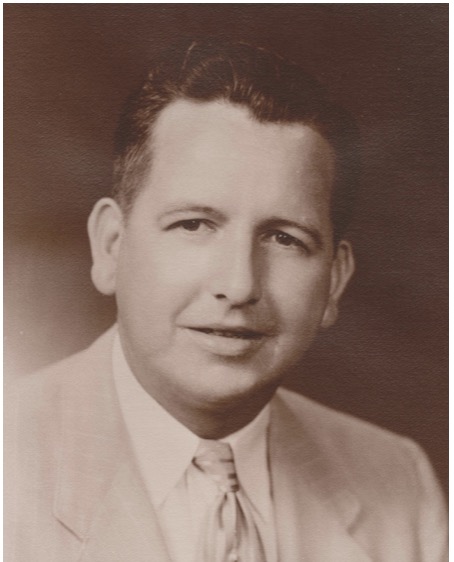 During a trip to the Will Rogers Memorial Museum in Claremore, Mr. Gilcrease stopped by the Five Tribes Trading Post, a curio shop owned by then Claremore Mayor Jim Hammett, and shared his financial troubles. Recognizing a massive cultural opportunity, Hammett immediately put together a plan to acquire the collection for Claremore.
The plan was so far along that it made national headlines, including coverage in Time Magazine, The New York Times and the Holiday Magazine. Panicked by the prospect of losing a world-class collection of Western and Native American art, civic leaders and voters in Tulsa quickly counter attacked.
The following excerpts from Mr. Hammett’s personal notes recount the incidents around “The Claremore Plan”.
On a Saturday afternoon in October 1953, Mr. Thomas Gilcrease, accompanied by his niece, Betty Gilcrease, came to Claremore to see me. I was at that time in my third of five terms as mayor of Claremore.
Mr. Gilcrease related to me his pressing financial problems in paying for some of his more recent acquisitions of art and sculpture for his collection housed in the Gilcrease Museum adjacent to his home in north Tulsa.
One of the major debts was to the Knoedler Galleries in New York City. Although it was obviously painful for Mr. Gilcrease to have to talk about his financial situation, he was very forthright about it. Maybe it was because he was part Creek Indian and I am a quarter-blood Cherokee.
He told me that the State of Texas was aware of his financial plight and was offering to purchase the collection and move it to the University of Texas at Austin. He wanted the collection to stay in Oklahoma if there was any way that this could be done, but unless he were able to satisfy his most pressing creditors rather quickly, he would have to accept the Texas offer. He also stated that Tulsan’s did not believe he was serious about the strong probability that the collection was going to Texas.
After a lengthy discussion, I invited Mr. Gilcrease and Betty to go for a drive as I had an idea to present to him. We drove around the Will Rogers Memorial and I parked on Blue Starr Drive adjoining the Memorial on the north. Across BIue Starr, north of the Memorial, there were at that time 8 to 10 small houses situated upon approximately 12 acres. We got out of the car and I pointed to the land and said to Mr. Gilcrease, “Wouldn’t it be wonderful to have the Gilcrease Museum located on this beautiful hilltop overlooking Claremore and right across the street from the Will Rogers Memorial? Also, this location would afford the thousands and thousands of annual visitors to the Wil Rogers Memorial the opportunity to also see the Gilcrease collection and would appropriately tie-in with the Will Rogers Memorial,” I continued. Mr. Gilcrease’s eyes twinkled and he replied, “it certainly would be a fine location.”
We then returned to my home for further discussion. He asked. “How would you plan to finance buying the land and make the necessary improvements? I told him that I believed that after the costs were established by an architectural and engineering firm, we could call and pass a city revenue bond issue to raise the necessary monies to buy the land, construct the buildings and pay his debts to the galleries. He said that he really liked the plan, that he would give the collection to the city and that he would pledge enough of his oil royalties to amortize the bond issue. Then, he remarked that such a plan would take at least a year to complete and that his debtors would not allow him that much time. We then discussed the debt that he felt had to be paid soon. As I recall, the total was about $500,000. There were others, but Mr. Gilcrease felt that if we could come up with the one-half million, the others would wait on our bond issue. I told Mr. Gilcrease that I would start to work on the proposal at once and that I would be in touch with him the early part of the next week.
On the following Monday morning, I called Governor Johnston Murray at the state capitol and outlined what we proposed to do. I suggested that he appoint a five-member board to plan and act. The governor asked me for recommendations. I suggested Dr. Noel Kaho, Claremore dentist, who was very innovative and knowledgeable in art circles and Morton R. Harrison, Chairman of the Oklahoma State Planning and Resources Board and Part-Owner of the Hotel Will Rogers.
The governor then said those gentlemen were fine with him. In addition, he wanted to name J.G. Puterbaugh, owner of McAlester Fuel Co., and Harry Gibson, president of the 1st National Bank of Muskogee and me as an ad hoc board of trustees to plan and carry out the project.
At our initial meeting on Wednesday, a “stud horse” note was drawn and signed by the five trustees and a bank loan was obtained as I recall for about $500,000. The most pressing debts were paid and this cut us some slack to permit us to proceed with the project. Judge Lester Whipple of San Antonio, a close friend of Mr. Gilcrease and chief counsel of the Gilcrease Oil Co. met with us several times during the next two weeks to draft necessary arrangements to pledge royalties from Gilcrease Oil to amortize our proposed bond issue.
I visited with each of the property owners of the proposed site and obtained options to purchase their properties. Payment was to be made and titles transferred when funds were made available from a successful bond issue. We then met with consulting engineering firms and Claremore civic groups preparatory to calling a bond issue. It was at this point that the political and civic leaders of Tulsa got involved and stepped in.
Now, convinced for the first time that Mr. Gilcrease’s financial problems were real and that the collection was going to be lost, either to Claremore or to Texas. The Tulsa ‘movers and shakers’ went all out with a successful campaign to retain the Gilcrease treasure. The Claremore stud horse note was paid off by Tulsa interests and the City of Tulsa on August 24, 1954, voted a bond issue for $2.25 million which kept the Gilcrease collection in Tulsa.
Although we were unable to secure the Gilcrease collection for Claremore, in the final analysis, I believe that our efforts resulted in its staying in Tulsa and not being lost to Texas. Not only did our efforts result in saving the treasure for Oklahoma but it gave me and my associates the opportunity to become intimately acquainted with a truly great and fascinating individual, Thomas Gilcrease. This wise, gentle, gracious and courtly man touched and enriched all of our lives and he lives on through the Gilcrease Museum of American History and Art.
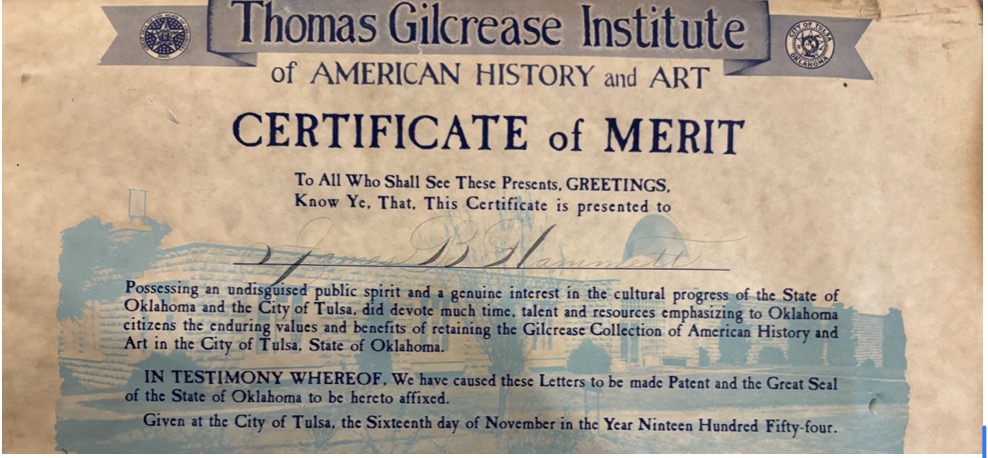
Here in Claremore, we like to consider our small town as Museum City given our current representation by the Oklahoma Military Academy Museum, the Will Rogers Memorial Museum, the JM Davis Arms and Historical Museum and the Claremore Museum of History. Consider what our landscape would look like today if in addition to these organizations we still had Long’s Museum where Reasor’s is located, the Doll Museum where Wendy’s is located and then Gilcrease Museum sitting next to the memorial on top of the hill.
We agree with then Mayor Hammett and are proud to know that “The Claremore Plan” helped keep this wonderful institution in our great state.

